10 October 2026
Start by measuring your equipment, not guessing
The most reliable way to size a machinery shed is to measure your largest machine, including any attachments like a bucket, boom or implement in its stored position, and then add clearance for walking around it, opening doors or cabs, and manoeuvring in and out. Do this for every type of machine or vehicle that will use the shed, not just the biggest one, since a shed sized only around a tractor might not actually suit a wider header or a truck with a trailer attached.
- Measure overall length, width and height with attachments in their stored position, not folded or removed.
- Allow clearance on all sides for opening doors, walking around the machine, and turning while reversing in.
- Account for the tallest item, including any aerials, exhaust stacks or raised equipment, when setting the roof height and door height.
- Think about future equipment too, since machinery tends to get larger over time, not smaller.
Working out bay widths
Rather than relying on standard bay sizes, work out what needs to fit in each bay and size it around that. A bay that stores a single tractor needs different width to one that needs to fit a tractor alongside an implement, or a ute and trailer parked side by side. It helps to sketch out roughly where each piece of equipment will sit day to day, since this often reveals that more width or depth is needed than a quick guess would suggest.
Drive-through access
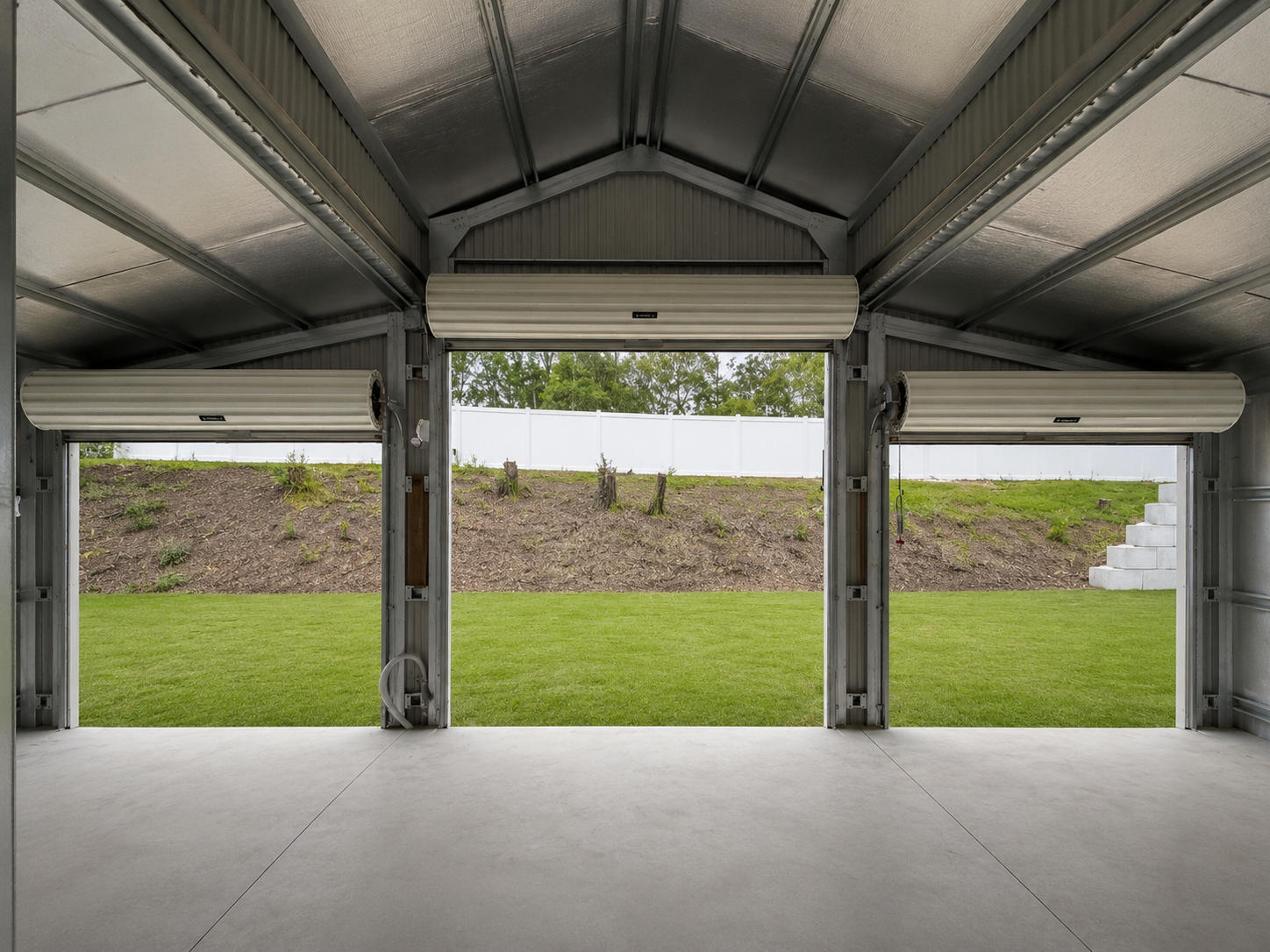
A drive-through bay, with an opening at both ends, lets equipment enter from one side and exit the other without reversing. This is particularly useful for machinery that is awkward to reverse, such as vehicles towing implements or trailers, or for sheds used frequently during busy periods like harvest, when time spent manoeuvring adds up. Drive-through access needs space at both ends of the shed, so it is worth confirming early whether the site allows for it.
Open bays versus enclosed storage
Open bays, without doors, suit equipment that is used frequently and benefits from quick, unobstructed access, since there is no door to open and close each time. Enclosed bays with roller or sliding doors suit equipment that needs more protection from weather, dust or theft, or items stored for longer periods. Many machinery sheds combine both, with open bays for daily-use equipment and an enclosed section for tools, parts or less frequently used machinery.
- Open bays work well for frequently used equipment where quick access matters most.
- Enclosed bays suit longer-term storage, tools, or equipment needing more protection.
- A mix of both is common and should be based on how each piece of equipment is actually used.
Awnings and lean-tos
An awning or lean-to extending off the main shed roofline adds covered space without the cost of a fully enclosed structure. This can work well for equipment that needs protection from sun and rain but not full enclosure, or for extra undercover space for workshop activities, loading or parking. Awnings are generally added to one or more sides of the main shed, and the structural requirements for the extension should be confirmed with your builder and engineer alongside the main building design.
Planning for how the shed is actually used
Beyond fitting the equipment itself, think about how people move through the shed day to day. Leave room for a workbench or tool storage area if needed, consider how machinery will be moved in and out during busy periods, and think about whether multiple people might need access to different equipment at the same time. A layout that works on paper but creates a bottleneck in practice is a common and avoidable mistake.
Getting the layout right before you build
Because every property and equipment list is different, there is no single standard size or layout that suits every machinery shed. The most reliable approach is to measure your actual equipment, think through how the shed will be used day to day, and work with your builder to translate that into a practical layout and a structurally sound design for your site.
Planning a machinery shed and not sure what size you need? Call Archon Sheds on 0408 881 497 or get in touch to talk through your equipment and site.
Get a free quoteFrequently asked questions
How do I work out what size machinery shed I need?
Measure your largest equipment, including attachments, in its stored position, then add clearance for movement and door access. Do this for every type of machine that will use the shed, not just the biggest one.
Should a machinery shed have drive-through access?
Drive-through access is useful for equipment that is awkward to reverse or for sheds used heavily during busy periods, but it needs space at both ends of the building, so it should be checked against your site.
Is it better to have open bays or enclosed bays in a machinery shed?
It depends on how the equipment is used. Open bays suit frequently used machinery needing quick access, while enclosed bays suit longer-term storage or equipment needing more protection. Many sheds use a mix of both.
Can an awning be added to a machinery shed later?
Awnings can often be added to an existing shed, but the structural requirements depend on the original building and should be assessed by your builder and engineer before proceeding.
Does Archon Sheds build custom-sized machinery sheds?
Yes, Archon Sheds designs and builds custom-sized machinery sheds for rural properties across the Gold Coast, Brisbane and South East Queensland, with supply and install or install only options.